
Payday Super 2026: Are You Ready for the Biggest Superannuation Change in a Decade?
The $450 monthly threshold is gone and quarterly super payments end in days. From 1 July 2026, employers must pay super every payday. Here's what you need to know to avoid penalties.
BUSINESS OWNERS
Kirpal
6/29/20263 min read
URGENT: Two Critical Superannuation Changes You Cannot Ignore
Before we dive in, two major updates every employer must know:
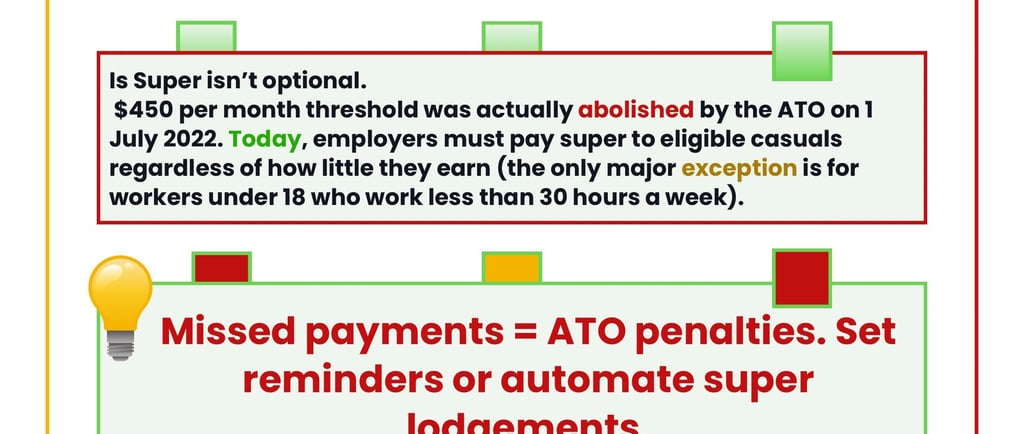
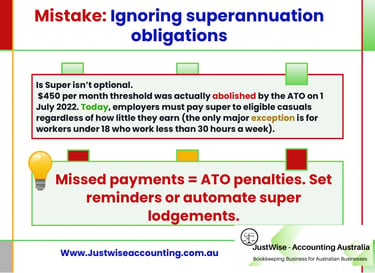
The $450 monthly threshold is GONE – Since 1 July 2022, you must pay super to eligible employees regardless of how much they earn. The old $450/month rule no longer applies.
Quarterly super payments END in DAYS – From 1 July 2026, employers must pay super every payday (weekly, fortnightly, or monthly) – not quarterly. Payments must reach the employee's super fund within 7 business days after payday.
These changes start in just days. If you're not ready, you risk penalties.
The $6 Billion Problem: Why Ignoring Superannuation Obligations Is a Debt You Can't Outrun
Super isn't optional. It's not a "nice to have" or something you can get around to when cash flow improves. It's a legal obligation—and ignoring it is one of the fastest ways to turn a manageable business into one drowning in ATO debt.
The $450 Myth That Refuses to Die
Here's a misconception that's still circulating: "I don't have to pay super if they earn under $450 a month."
That rule died on 1 July 2022. If you're still operating under this belief, you're already behind and exposed.
Today, the rules are simple:
Employees 18 or older – you pay super regardless of how much they earn or how many hours they work
Employees under 18 – you pay super if they work more than 30 hours in a week
The rate – 12% of qualifying earnings (as of 1 July 2025)
It doesn't matter if they're full-time, part-time, casual, a temporary resident, a company director, or even a family member. If they're eligible, you must pay.
Example: A seasonal fruit picker working 15 hours a month earning $435 was ineligible for super in 2021. In 2025-26, that same worker is eligible for super guarantee. The rules have changed—have you?
Payday Super Starts 1 July 2026 – Are You Ready?
From 1 July 2026, quarterly super payments are officially a thing of the past.
Here's what changes in just days:
Pay super every payday – If you pay wages weekly, you pay super weekly. If you pay fortnightly, you pay super fortnightly. Monthly payroll means monthly super.
7 business day deadline – Super contributions must reach the employee's super fund within 7 business days after each payday. The clock doesn't stop if the payment is rejected.
Report through STP – You must report both qualifying earnings and super liability through Single Touch Payroll each payday.
Small Business Superannuation Clearing House (SBSCH) closes – From 1 July 2026, the SBSCH will permanently close. There is no replacement. Act now to download your records and transition to another provider.
First-year compliance approach – The ATO has confirmed that employers who try to do the right thing and resolve issues quickly won't be the focus of compliance action in the first year.
The Real Cost of Getting It Wrong
The ATO estimates that more than $6 billion of super contributions go unpaid each year. Payday Super is designed to reduce that—and the ATO will have real-time data to catch non-compliance faster.
If you miss a payment:
You must lodge a Superannuation Guarantee Charge (SGC) statement
SGC is calculated on salary and wages (including overtime and some allowances)
SGC is not tax deductible
You pay interest and additional fees
The ATO can now identify issues in near real-time
Practical Steps to Get Ready – Right Now
With just days until 1 July, here's your urgent checklist:
Check your systems – Your payroll software must support paying super each payday and reporting qualifying earnings through STP.
Run test payments – Check employee records are correct to avoid rejected payments.
Transition from SBSCH immediately – Download your records and move to another provider before it closes.
Plan your July cash flow – You will have multiple super payments due in July, including payments each payday PLUS the final quarterly payment due 28 July 2026.
Update employee details – Ensure you have correct super fund details for every employee.
Set up automations – Use payroll software that calculates and pays super automatically with each pay cycle.
The Bottom Line
Superannuation isn't a suggestion—it's a legal requirement with serious consequences. And from 1 July 2026, the rules change dramatically. Quarterly payments are gone. Real-time payments are here. The ATO has the data to catch errors faster than ever.
Don't let a missed payment become a six-figure headache. Act now.
Need help getting Payday Super ready? JustWise Accounting helps Mackay businesses transition to the new super rules, manage payroll, and stay compliant. Get in touch for a free consultation.


Stay in Touch
© 2025 JustWise Accounting. All rights reserved. ABN 85 581 353 385
⚠️ We respect your privacy. Unsubscribe anytime. (under subscribe button)







Serving Australia-wide
Justwise acknowledge the Traditional Owners of the lands where we operate and pay respect to Elders past and present.